Beyond GraphRAG 2.0: The Context Infrastructure Mandate
Gartner predicts that 60% of agentic analytics projects will fail by 2028 because “amnesiac” retrieval lacks the persistent business context needed for autonomous agents.
The Amnesia Problem
Traditional GraphRAG solves the hallucination problem—agents can look up verified facts. But every new prompt starts cold. No memory of prior decisions, no drift control, no compliance trail. An agent operating on stale assumptions is a liability, not an asset.
- Answers: What is this entity?
- Retrieves verified facts on demand
- Resets with every prompt
- No record of prior decisions
- Answers: Why did the agent act?
- Persists the full decision trace
- Accumulates across interactions
- Compliance enforced on every interaction
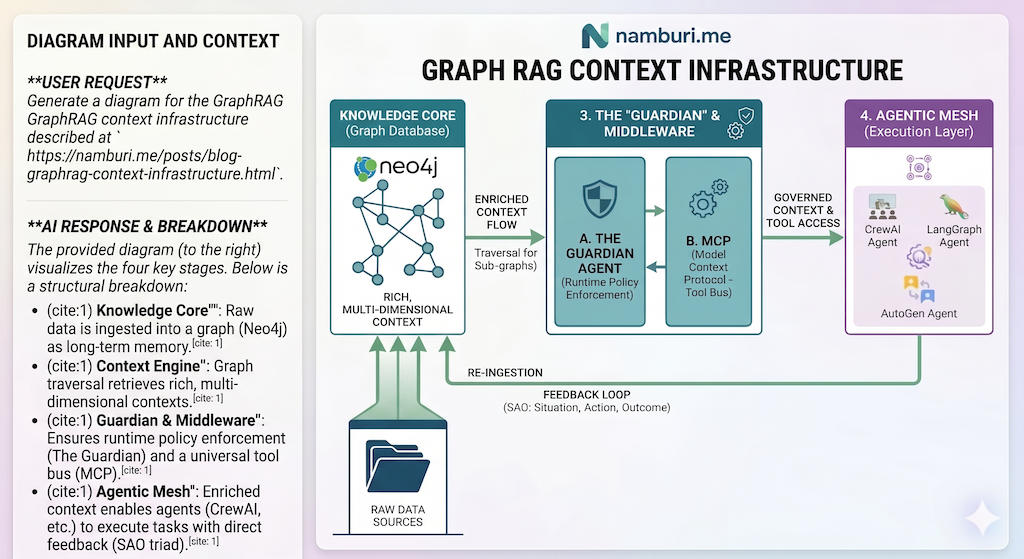
To build agents that scale safely, organizations must move beyond static retrieval and implement a Unified Semantic Foundation—one governed by a Guardian Agent that enforces compliance at runtime, not after the fact.
The Architecture
The Context Infrastructure Mandate runs on two axes: a horizontal data foundation in three phases, and a vertical enforcement layer that governs every decision those phases produce.
The Horizontal Foundation — The “Where”
Knowledge Graph
The static business domain rules—entities, relationships, verified facts. Business rules for currency conversion, routing, and risk thresholds are derived from this layer.
Context Infrastructure
The live “How and Why” telemetry layer. Keeps the agent’s model synchronized with production—when real-world conditions diverge, the gap surfaces before it causes a failure.
Persistent Memory
The long-term decision trace ledger. Maps provenance of every decision, from fraud-risk elevation to cross-border compliance routing.
The Vertical Impacts — The “What”
Semantic Validation
Is this reasoning path logically consistent with the business context? Catches agents that bypass reconciliation steps or violate domain rules mid-execution.
Integrity Verification
Is this outcome legally and operationally permissible? Distinguishes a result that computes from a result that is compliant.
Both outcomes are enforced by a single runtime node.
Meet the Guardian Agent
The Guardian Agent is not another worker in the pipeline—it is the Runtime Controller sitting between the LLM and your transactional systems. Every action passes through it before reaching the ledger.
Reasoning Interception
Captures intent at the planning stage—before execution. Analyzes the full plan before it touches any downstream system.
Semantic Validation
Checks alignment with the Context Mandate—confirms, for instance, that an agent doesn’t skip reconciliation during a high-volume settlement window.
Integrity Verification
Determines if an outcome is legally and operationally permissible—distinguishes a result that computes from a result that is allowed.
Machine-Verifiable Contracts
Turns code-level governance into automated infrastructure—enforces compliance automatically, no human sign-off required.
Blueprinting the Implementation — The SAO Path
Every agent interaction is written to the Context Graph as a connected Decision Trace—not an isolated log entry—using the SAO (Situation, Action, Outcome) triad.
Environmental Snapshot
Full context at decision time: user identity, IP origin, transaction amount, risk score, jurisdiction. What was true when the agent acted.
Thinking Log
Reasoning steps, tool calls, intermediate outputs. Every branch recorded—including paths not taken.
Validation Record
Success, failure, or human-intervention log—with the Guardian’s compliance verdict. What happened and whether it was permissible.
Querying the SAO path surfaces answers impossible with stateless retrieval: “Show me every agent action in a cross-border settlement that triggered a risk-elevation event in the last 30 days.” This is governance-as-infrastructure.
Curing “Context Rot”
There’s an engineering reality to address: as the Context Graph grows, so does the risk of graph bloat and token costs. Redundant history clutters reasoning and inflates inference spend. Three maintenance levers keep the runtime lean:
Semantic Consolidation
Merges repetitive SAO traces into “Learned Patterns”—prevents the graph from becoming a data swamp.
Temporal Decay
Purges transient data post-execution; governance outcomes hardened into permanent storage.
Prompt Compression
Injects only high-relevance nodes into the LLM—cuts token overhead by up to 60%.
Conclusion
Moving beyond GraphRAG 2.0 means accepting that governance is no longer a human-in-the-loop bottleneck—it is infrastructure. The Guardian Agent doesn’t slow agents down; it makes them trustworthy enough to run without supervision.
The organizations that implement this stack first won’t just avoid the 2028 failure statistic—they’ll be operating at a level their competitors can’t audit, let alone match.