Building the AI-Ready Data Framework
The generative AI revolution has transformed "Can AI do this?" from a philosophical inquiry into a practical business imperative. Yet the answer depends less on AI capabilities themselves and more on a fundamental prerequisite: data architecture maturity.
As organizations prepare to implement generative AI, a critical question emerges: Can my data architecture support AI at scale? Enterprises that succeed share a common characteristic — they have built robust data ecosystems that make information accessible, trustworthy, and AI-ready. This article presents a comprehensive framework for establishing that foundation.
1. Define the AI Readiness Framework
Before selecting a technology stack, two points of alignment are critical: mapping business objectives to technical patterns and conducting a rigorous audit of existing data assets.
Strategic Alignment: Mapping Business Objectives to Technical Patterns
Semantic Retrieval & Similarity
Traditional databases rely on keyword matches. Vector patterns convert data into high-dimensional embeddings, allowing AI to interpret the meaning and intent behind a query rather than just the text.
Relational Intelligence & Multi-Hop Reasoning
Complex business questions require connecting dots across multiple degrees of separation. Graph patterns treat relationships as first-class citizens, enabling AI to traverse networks impossible for standard relational tables.
Structured Analytics & Conversational BI
LLMs bridge the gap between natural language and SQL, allowing non-technical users to query massive data lakes using plain English — no code required.
Knowledge Base Assessment
A comprehensive audit across three data dimensions forms the foundation for all subsequent architectural decisions:
The Analytical Core
Focus on high data quality and robust metadata/schemas. AI success depends on the model's ability to understand table relationships to generate accurate queries.
The Contextual Bridge
Focus on parsing and flattening. Flexible but predictable schemas act as a bridge, connecting unstructured narratives with structured records.
The Generative Frontier
Implement a robust embedding and chunking strategy. The architecture must transform these assets into high-dimensional vectors so AI can retrieve segments based on meaning.
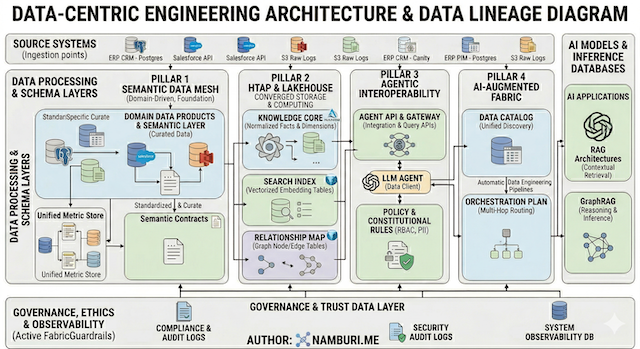
2. Data Strategy: The Four Pillars of AI-Ready Architecture
To transform disparate data into specialized architectures — Vector, Graph, Lakehouse — four sequential pillars are required:
The Semantic Data Mesh
Before AI can "read" data, that data must have clear meaning. This pillar shifts from centralized IT bottlenecks to a model where business domains (Finance, HR, Engineering) own their data products and the associated Semantic Layer.
- Semantic Integrity: Domain experts define business logic, ensuring the AI doesn't misinterpret terms like "Revenue" or "User Intent."
- Unified Metric Store: Domains publish standardized metrics (e.g., Gross Margin) rather than raw columns, ensuring consistent answers enterprise-wide.
- AI-Ready Products: Every data product ships with a "semantic contract" an AI agent can read immediately, ensuring Text-to-SQL queries return business-accurate answers.
Hybrid Transactional / Analytical Processing (HTAP)
Unification of operational (OLTP) and analytical (OLAP) workloads allows AI to access real-time transactional data and historical analytics within the same footprint. The Lakehouse becomes a comprehensive Data Intelligence Platform where specialized capabilities are integrated features, not silos.
- Knowledge Core (Analytical/Operational): Central repository of verified facts, business logic, and historical truths.
- Search Index (Vector): Semantic gateway that allows the Lakehouse to understand intent and context.
- Relationship Map (Graph): Connective tissue enabling AI to traverse complex, multi-layered associations.
Operational Intelligence
Query live operational data and historical trends simultaneously — without complex ETL latency.
Simplified Topology
Collapse walls between specialized stores, eliminating the architectural tax of separate siloed databases.
Converged Formats
Open-source table formats (Apache Iceberg, Delta Lake) ensure AI tools can access data without proprietary lock-in.
Agentic Interoperability
A standardized interface layer (such as Model Context Protocol) decouples AI from databases, allowing agents to move beyond "retrieval" and start "acting."
- Autonomous Workflows: Universal interfaces allow AI to trigger actions in external systems based on data insights.
- Modular Architecture: Back-end upgrades (e.g., swapping Vector DBs) happen without rewriting AI application logic.
- Natural Language Gateways: Complex query languages replaced by "Natural Language to SQL" engines for instant insights.
- The Connectivity & Control Gateway: A secure interface that enforces "Constitutional" rules—such as Policy-as-Code and Dynamic Redaction—to ensure autonomous AI actions remain strictly within pre-defined business and safety boundaries.
AI-Augmented Fabric & Orchestration
The ecosystem's technical "brain" — a self-orchestrating fabric that leverages AI to automate data engineering, migration, and security at scale.
- No-Code / AI-Driven ETL: Visual and natural language pipeline builders let non-technical users create high-quality data streams.
- Automated Discovery: A unified catalog enables self-discovery of which data products are relevant to a specific user prompt.
- Orchestrated Movement: When complex Multi-Hop Queries require data from multiple sources, the fabric intelligently routes and caches information.
3. Tools & Techniques: RAG Architectures for Enterprise AI
Retrieval-Augmented Generation (RAG)
RAG serves as the contextual memory for AI agents. By chunking unstructured content into segments and storing them as high-dimensional vectors, RAG allows LLMs to "look up" relevant facts before generating a response.
Graph-Enhanced RAG (GraphRAG)
GraphRAG is the reasoning layer of AI. By extracting entities and their relationships into a Knowledge Graph, it creates a structured map of interconnected nodes.
4. Storage Architecture: The Converged Engine Model
Modern AI doesn't require separate databases — it requires a Converged Engine Model where specialized storage patterns exist within a single, unified footprint. This eliminates the architectural tax of data movement and gives the AI agent a single source of truth.
Knowledge Core
Analytical & Operational. Verified business logic and real-time transactions.
Search Index
Vector storage for sub-second semantic retrieval and intent understanding.
Relationship Map
Graph engines for multi-layered network traversal and high-reasoning accuracy.
Permanent Archive
Low-cost object storage for raw files and long-term training data retention.
5. Governance, Ethics & Observability
In an agentic ecosystem, governance must move from manual checklists to an automated, Active Fabric that provides real-time guardrails across the entire stack.
🛡️ Active Governance
Automated lineage tracking, RBAC, and sensitivity labeling provide "policy DNA" that enforces GDPR/CCPA compliance by default, ensuring privacy at the moment of execution.
⚖️ Responsible AI
Continuous bias detection and model explainability to maintain human oversight and trust in automated agentic reasoning.
🔒 AI Security
Using AISPM tools to monitor and block malicious behavior or manipulated data in real time.
📊 Full-Stack Observability
Real-time monitoring of data freshness, model drift, and system latency to ensure the Knowledge Core remains reliable and performant.
Building AI-Ready Data Architecture: Next Steps
The shift from data management to Data Intelligence is the defining challenge of the Agentic era. Success requires unifying the operational and analytical cores under a domain-driven framework to build an architecture that is scalable, reliable, and trustworthy.
Ultimately, a mature data strategy is the only way to transform the question "Can AI do this?" into a permanent and sustainable competitive advantage.