The Negotiator: Why Data Governance Must Stop Saying "No"
In the traditional data stack, security is a brick wall. When an autonomous agent hits a policy—whether a PII guardrail in Snowflake or an entitlement block in Databricks—the system returns a 403 Forbidden and the mission dies. This is Agent Stall: it turns autonomous workflows into manual support tickets, paralyzing the very AI productivity we aim to build. To solve it, we must shift from reactive "Sentry" models toward Agentic Governance.
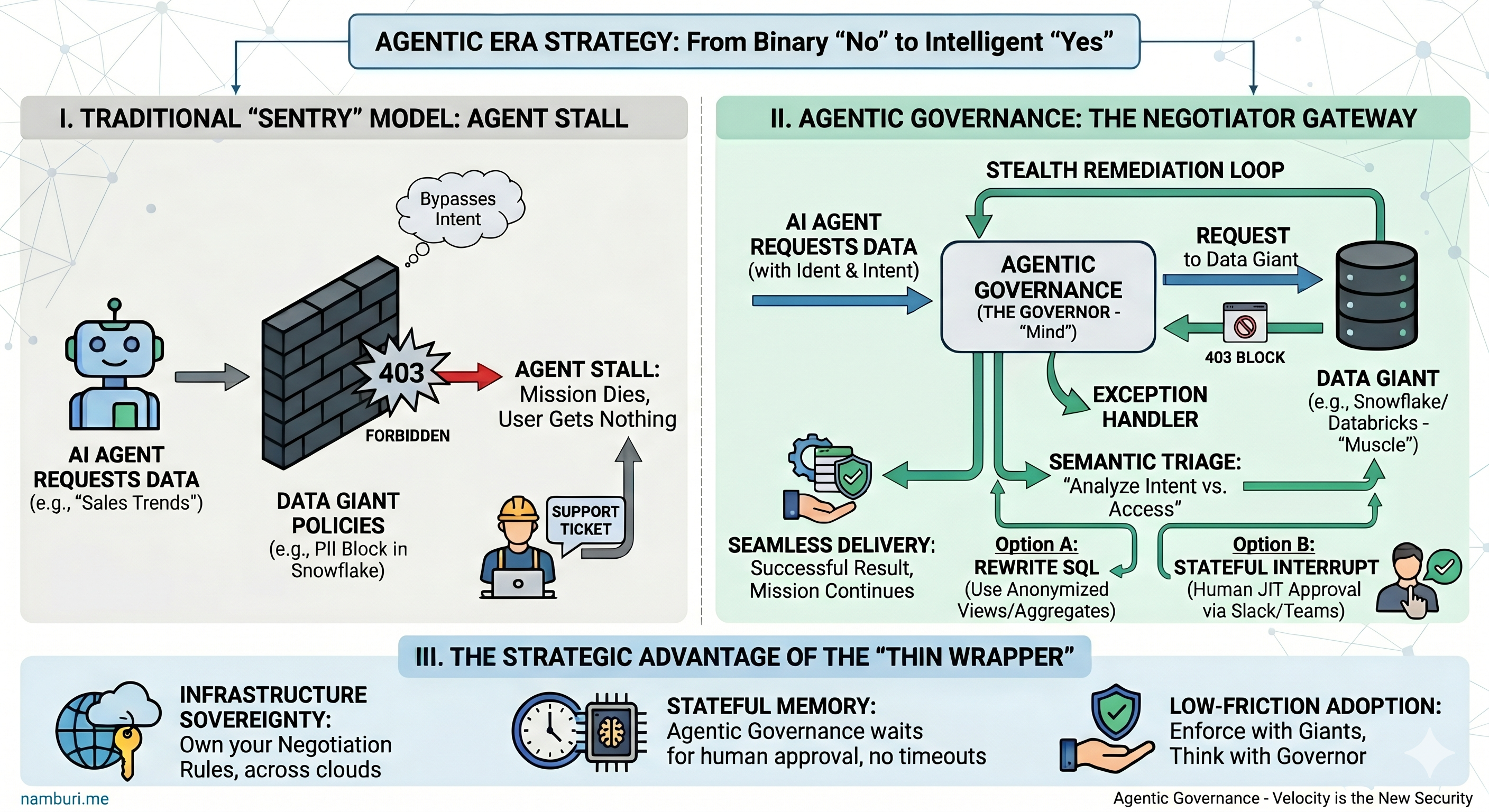
Agent Stall
- 403 blocks kill autonomous workflows
- Intent-blind platforms can't negotiate
Stealth Remediation
- Intercept → Triage → Pivot → Deliver
- Agent never sees the block
Governance Layer
- Cloud-portable governance logic
- Stateful memory across approval waits
I. The Problem: The "Amnesic" Data Giant
The "Big 5" platforms—Snowflake, Databricks, AWS, Google, and Microsoft—are built for Static Enforcement. They are the "Muscle" of the data world: powerful, literal, and binary. This architecture made sense when humans issued every query. It breaks completely in the agentic era.
Intent-Blind Blocking
If an agent requests "Sales Trends" but the table contains a single sensitive email column, the Giant blocks the entire query—regardless of whether that column is relevant to the agent's actual goal.
- Trigger: Any policy match on any column in scope
- Response: Binary — 403 Forbidden, full stop
- Outcome: Agent errors out, user gets nothing
No Semantic Context
The database doesn't understand why the agent is asking for the data. It cannot distinguish between a request for raw PII and a request for an aggregate trend that happens to touch a PII-adjacent table.
- Missing: Intent awareness
- Missing: Partial fulfillment options
- Missing: Just-in-time escalation path
II. The Solution: The Governor as a "Pre-Frontal Cortex"
In the Agentic Governance paradigm, the caller never speaks directly to the Giant. Instead, all requests route through an intelligent gateway—a lightweight logic layer that intercepts failures and finds a path to Yes via a Stealth Remediation Loop.
The Intercept
The Governor catches the 403 exception before the agent fails. From the agent's perspective, the request is simply in flight—it has no visibility into the remediation that is about to begin.
Semantic Triage
The Governor analyzes the intent behind the failure: "Does the agent actually need the raw PII, or would an anonymized aggregate satisfy the goal?" This question drives the pivot decision.
The Proactive Pivot
Option A — Rewrite: The Governor automatically rewrites the SQL to use anonymized views or aggregates and re-submits it without surfacing the failure.
Option B — Escalate: If raw access is genuinely required, it triggers a Stateful Interrupt, pinging the data owner via Slack or Teams for Just-In-Time (JIT) approval.
Seamless Delivery
The agent receives compliant data and continues its mission. It never knew a block occurred. The workflow heals itself without human intervention—unless policy explicitly requires one.
III. The Strategic Advantage of the Governance Layer
Deploying governance as a lightweight logic layer—rather than a heavy secondary platform—offers three distinct advantages that compound over time.
Cloud-Portable Rules
Governance logic isn't locked into one cloud vendor. If you migrate from Snowflake to BigQuery, Negotiation Rules move with you. Policy becomes a portable asset, not a platform dependency.
Wait Without Forgetting
Unlike stateless databases, this layer uses Checkpointers to save agent state during a human approval. It can pause for hours waiting for a manager's click—then resume the mission instantly with full context intact.
Wrap, Don't Replace
You don't rip and replace existing security. You wrap it—letting the Giant handle physical enforcement while the Governor handles intelligent negotiation. Existing investments in platform security remain valid.
The Verdict: Governance Velocity Is the Real Competitive Advantage
The most secure data isn't the data that's locked away—it's the data used correctly and contextually. A governance model optimized for the word "No" was designed for a world where humans issued every query. Agents operate at machine speed, machine volume, and machine concision. They need a governance model that matches.
Agentic Governance transforms data stack from a series of roadblocks into a Self-Healing Loop. It ensures policies protect the enterprise without paralyzing the AI. The two goals—security and velocity—are not in tension when the layer between them is intelligent.
Use the Big 5 for the Muscle of enforcement, but route requests through a governance layer for the Mind of governance. That is how you win the Agentic Era.