From Hallucinations to Hyper-Personalization: How GraphRAG Grounds AI in Knowledge Graph
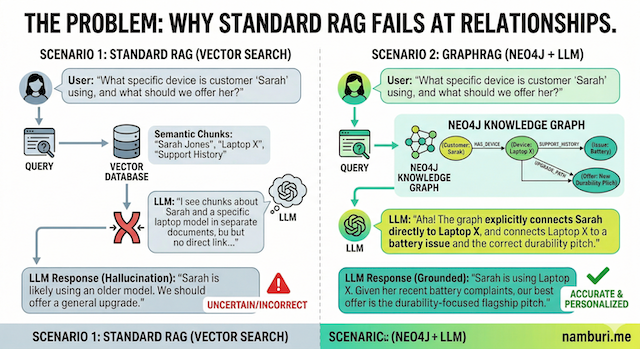
You deploy an LLM assistant, the demo goes well, then a real customer asks: "What device is Sarah using, and what should we offer her?" The model answers confidently—and wrong. That's not a model problem. It's a data access problem. Standard RAG fetches relevant documents but can't follow relationships between them. GraphRAG pairs a Knowledge Graph with an LLM so the AI reasons over actual connected data. Stack: Neo4j for the graph, LangChain and LangGraph for orchestration, LlamaIndex for natural language to graph queries.
Four Enterprise Problems GraphRAG Solves
Hallucinations
LLMs fill gaps with plausible guesses. GraphRAG retrieves verified facts first—device model, purchase date, support history—and grounds the prompt before the model writes a word.
Disconnected Data
Vector search finds similar text but can't answer multi-hop questions. Neo4j's Cypher traverses relationships across graphs in a single query.
Generic Responses
Same LLM, same template—different sub-graph per user. Priya's frequent-traveller history surfaces a flagship pitch. Marcus's battery complaints surface a durability pitch. Same model, accurate results.
No Graph Expertise Required
LlamaIndex's NL2GraphQuery translates plain English into Cypher automatically. Business users type; the stack handles the query.
The GraphRAG Stack: Neo4j, LangChain, LlamaIndex
- Neo4j — stores entities and relationships as a native property graph, queried via Cypher. Available self-hosted or AuraDB.
- LangChain — manages prompt templates and LLM calls. Model-agnostic: OpenAI, Anthropic, Mistral, or local models all plug in the same way.
- LangGraph — orchestrates multi-step reasoning as a stateful workflow. Complex questions don't get crammed into one overloaded prompt.
- LlamaIndex — handles NL-to-Cypher via
KnowledgeGraphIndexandNeo4jGraphStore, bridging natural language and the graph.
Query flow: question in → Cypher out → Neo4j sub-graph returned → LangGraph loops if needed → LangChain generates the grounded response.
Standard RAG vs. GraphRAG
| Feature | Standard RAG (Vector) | GraphRAG (Neo4j) |
|---|---|---|
| Data Structure | Unstructured text chunks | Structured entities & relationships |
| Search Method | Semantic similarity | Relationship traversal (multi-hop) |
| Best For | Finding a relevant document | Finding connections between data points |
| Personalization | Segment-level at best | Individual sub-graph per user |
| Accuracy on Specific Facts | Drops as questions get specific | Grounded in verified graph data |
GraphRAG Enterprise Use Cases
- Retail — Customer 360 graphs drive recommendations built on actual purchase history, not category averages.
- Telecom — Network and subscriber graphs surface the exact facts relevant to one customer's issue, instantly.
- Financial Services — Fraud and compliance queries require entity relationship traversal—vector search can't do this reliably.
- Healthcare — Patient graphs (diagnoses, medications, allergies, labs) give clinical tools precise, interconnected context where accuracy is non-negotiable.
Getting Started with GraphRAG
The tooling is mature. The harder work is upfront design:
- Sketch ontology — define entity types, relationships, and key properties before writing any code.
- Run Neo4j — AuraDB Free is enough for a proof of concept; scale to Enterprise when ready.
- Connect an LLM via LangChain — start with whatever fits cost and latency targets; swap models later without touching the graph pipeline.
- Add LlamaIndex —
Neo4jGraphStoreandKnowledgeGraphIndexwire up NL2GraphQuery in minimal configuration. - Use LangGraph for multi-step queries — once you're chaining lookups, explicit state management beats prompt hacks.
Is GraphRAG Worth Building for Enterprise AI?
If AI keeps getting specifics wrong or recommendations feel generic, the issue is almost always retrieval—not the model. GraphRAG is the practical fix: open-source tools, no cloud lock-in, and an architecture that scales from pilot to production without a rewrite. In an AI-first data strategy, this graph is the Knowledge Core—the verified, relationship-rich foundation every agent in the ecosystem reasons from.