Beyond the Bot: The Enterprise Agentic Playbook
The "Chat with your PDF" era is dead. The shift is from experimental toys to Autonomous Enterprise Ecosystems—where AI agents don't just answer questions, they run operations. Here's the production blueprint: the architecture decisions, collaboration patterns, and safety layers that separate real deployments from demos.
Lean & Fast Intelligence
Model routing + MCP for extensible, cost-disciplined inference.
Relational Intelligence
GraphRAG and Context Graphs for multi-hop, relationship-dense reasoning.
Orchestration
Orchestrator-Worker hierarchy with deterministic planning and central state.
Digital Workforce
Clean role boundaries and context-preserving handoffs between specialists.
Proactive Operations
Event-driven agents that observe and act before conditions become incidents.
FinOps & Guardians
Budget-aware agents, runtime compliance, and bounded autonomy as policy.
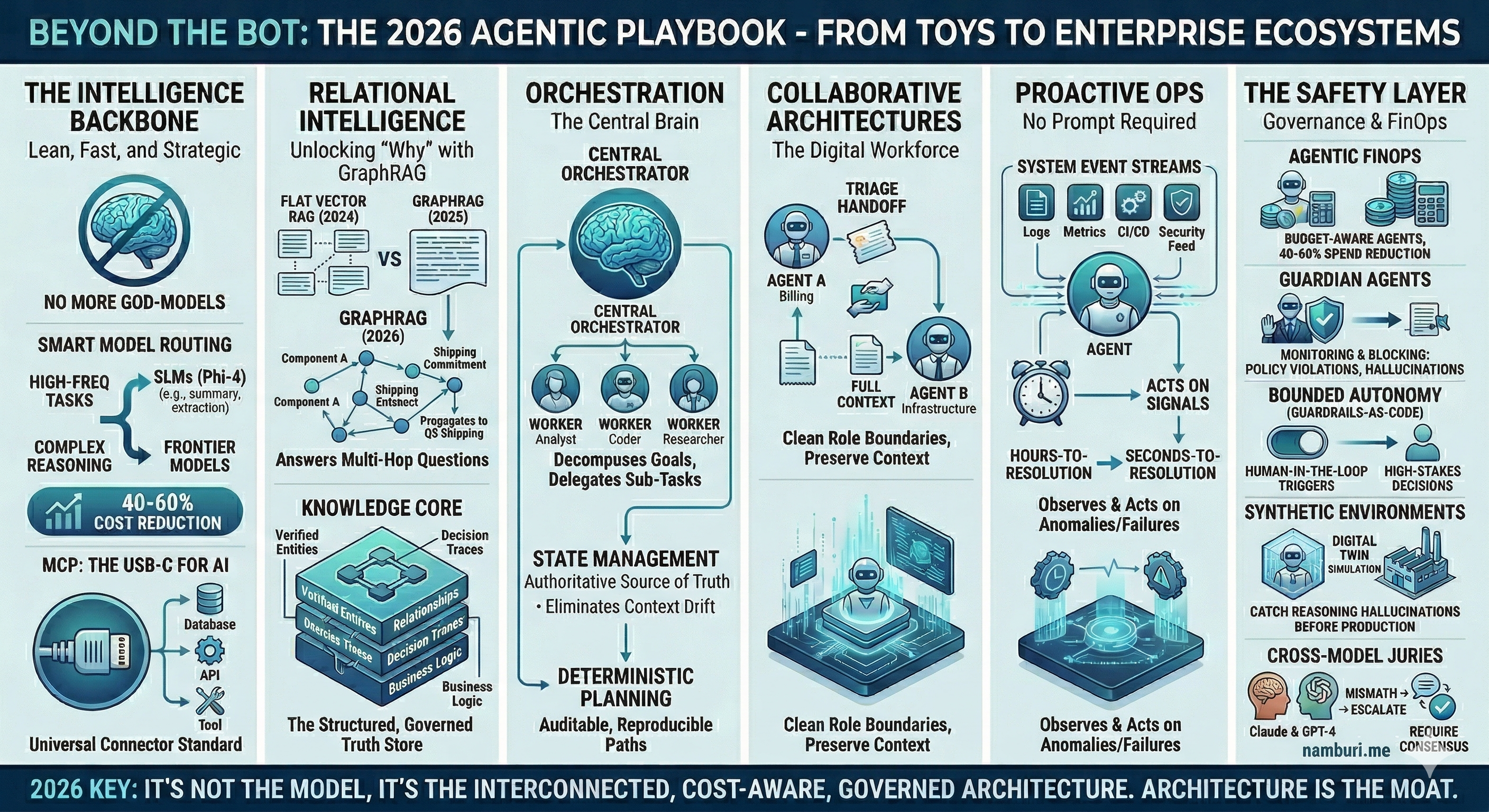
1. The Intelligence Backbone: Lean & Fast
Smart Model Routing. Route tasks to the cheapest capable model. Small Language Models (Phi-4) handle high-frequency work—classification, extraction, summarisation—at a fraction of the cost. Frontier models fire only for complex reasoning that genuinely demands them. Result: 40–60% cost reduction, no meaningful accuracy loss.
MCP: The USB-C for AI. The Model Context Protocol is the universal connector standard for agentic systems. Agents plug into any data source, tool, or API without custom integration code. Adopt it once; stay extensible as your ecosystem grows.
2. Relational Intelligence: Beyond Flat Data
Flat vector search can't answer relationship-dense enterprise questions like "How does a three-day delay in Component A propagate to Q3 European shipping commitments?" GraphRAG maps data as nodes and relationships, making multi-hop reasoning possible in milliseconds.
Context Graphs add a "Why" layer—a persistent record of every agent decision, the evidence used, and the outcome. Agents that learn from their own history stop making the same mistakes twice. In the AI-first data strategy, this is the Knowledge Core: the unified, governed truth store that grounds every agent response.
3. Orchestration: The Central Agent
Multi-agent systems without clear orchestration devolve into noise—agents duplicating work or silently dropping tasks. The fix is a deliberate hierarchy: a Central Brain decomposes goals into sub-tasks and delegates to specialists. The orchestrator holds the plan; workers execute. Neither role bleeds into the other.
Central state ownership eliminates context drift—every worker operates from the same ground truth. Deterministic planning ensures the same goal produces the same plan, enabling compliance reviews, debugging, and reproducibility that swarm approaches can't offer.
4. Collaborative Architectures: The Digital Workforce
Mature agent systems enforce clean role boundaries. A billing agent never attempts to resolve an infrastructure incident—it recognises the domain mismatch, packages the context, and hands off to the right specialist. Preserving full context across agent boundaries is one of the hardest and most important engineering challenges in agentic systems today.
5. Proactive Ops: No Prompt Required
Production agents live inside event streams—logs, metrics, security feeds, CI/CD pipelines. They wake on signals (an auth anomaly, a latency spike, a failed deploy) and act before outage. Hours-to-resolution collapses to seconds when the agent is already watching. No human prompt required.
6. The Safety Layer: FinOps & Guardians
Autonomy without accountability is a liability. These five mechanisms keep every autonomous action within policy bounds and economic constraints:
Budget-Aware Agents
- Estimate cost before executing
- Escalate or reroute if threshold exceeded
- 40–60% infrastructure savings vs unconstrained
Supervisor Agents
- Monitor outputs for policy violations + hallucinations
- Can block, roll back, or escalate in real time
- Runtime compliance, not post-hoc auditing
Bounded Autonomy as Code
- High-stakes decisions require human confirmation
- Enforceable policy, not advisory guidelines
- Agents run free where safe; humans stay in loop where it matters
Synthetic Environment Wrappers
- Run plans through a Digital Twin before production
- Catches reasoning hallucinations (right data, wrong logic)
Cross-Model Jury
- Two models run in parallel on high-stakes decisions
- Mismatch → human triage. Prevents single-model logic failures.
Production-Ready Checklist
- ☐ Orchestrator first — build the control plane before adding workers
- ☐ Audit handoffs — agents pass full context at every boundary, not just instructions
- ☐ Knowledge Graphs — migrate high-value knowledge out of flat vector stores
- ☐ Deploy Guardians — no worker runs in production without a supervisor
- ☐ Adopt MCP — stop building bespoke connectors
- ☐ Instrument FinOps — every agent call carries a cost estimate with a budget threshold
- ☐ Encode bounded autonomy — high-stakes decisions are HITL as policy, not suggestion
- ☐ Simulate before executing — run high-impact plans through Digital Twin first
- ☐ Cross-model consensus — critical decisions require agreement from multiple architectures
The Bottom Line
The race is no longer about which organization has access to the smartest model—frontier models are commoditizing fast. The decisive advantage belongs to organizations that build the most interconnected, cost-aware, and governed agentic architectures. Intelligence is abundant. Architecture is the moat.