The Semantic Sidecar Pattern: Decoupled Grounding for AI Agents
Every enterprise AI team faces the same divide: build the semantic schema first, or ship agents immediately? This is the "Chicken or the Egg" dilemma — and in regulated industries, both paths carry a compliance cost.
The schema-first path is responsible but stalls. Cross-team alignment across a legacy data landscape takes months — by the time it's ready, requirements have shifted and the window has closed.
The agents-first path ships fast but exposes the business immediately. An LLM on unmapped data produces confident, wrong answers — audit findings in financial services, flawed clinical decisions in healthcare. You can't patch your way out of a missing semantic layer.
The Sidecar Breaks the Deadlock
The Semantic Sidecar dissolves the dilemma by making schema-building a parallel, non-blocking activity. Developers wire agents to the sidecar while the core system stays untouched; ontologies and data mappings evolve incrementally — no big-bang overhaul required, no compliance gap while the schema matures.
Parallel Tracks
Build and wire agents to the sidecar while the core system remains stable and untouched.
Decoupled Velocity
Refine ontologies and data mappings incrementally — ship on Day 1 without waiting for a full schema overhaul.
Compliance from Day 1
Data grounding required for regulated sectors is in place from the start, with the complexity kept off the critical path.
Reduced Friction
Transforms a blocking prerequisite — build the schema first — into a side-by-side evolution alongside shipping.
How the three approaches compare across the dimensions that matter most in regulated environments:
| Schema-First | Agents-First | Semantic Sidecar | |
|---|---|---|---|
| Time to first agent | Months | Day 1 | Day 1 |
| Compliance posture | Delayed until schema completes | Exposed from launch | Grounded from Day 1 |
| Core system stability | Stable | Coupling risk | Stable |
| Schema evolution | Complete upfront | Skipped | Incremental, off critical path |
| Audit trail | Post-build | None | Full lineage from launch |
How It Works
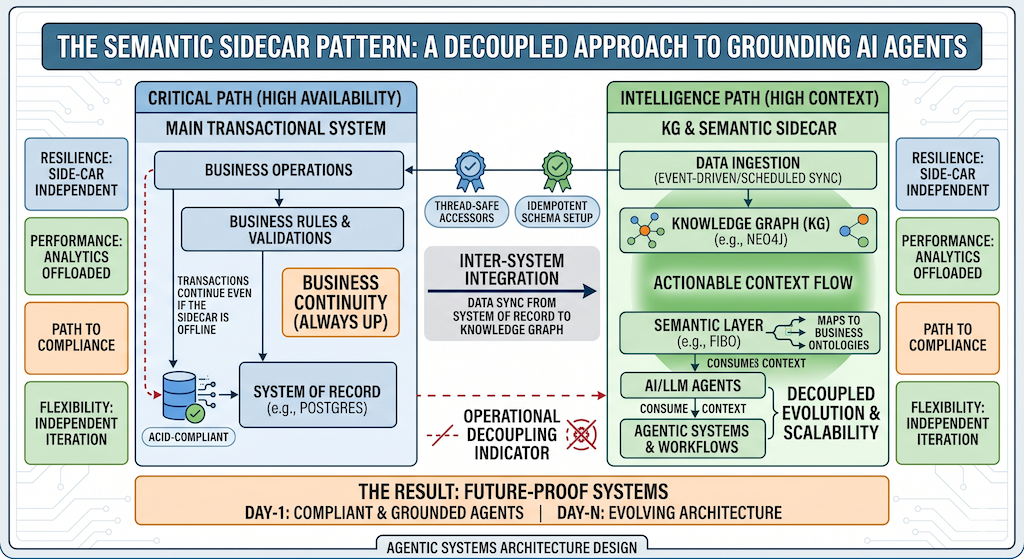
The Sidecar introduces a second service that runs alongside the core — receiving data changes asynchronously, building a Knowledge Graph, and serving validated, ontology-mapped context to agents. The core system never changes; the intelligence layer evolves continuously beside it.
- System of Record: Business data written to an ACID-compliant database (e.g., Postgres). Fully operational whether or not the sidecar is running.
- Business Rules: Core logic and validations enforced here, isolated from intelligence-path changes.
- Data Ingestion: Changes synced via CDC → streaming (Debezium/Kafka), event buses, or periodic ETL. Trades immediate consistency for decoupling — design reconciliation and SLAs accordingly.
- Knowledge Graph + Semantic Layer: Entities stored as connected nodes; domain ontologies map graph data to business-centric APIs that agents query. (Architecture detail: Beyond GraphRAG 2.0.)
Resilience and Performance by Design
Because the sidecar sits off the critical path, it can be updated or restarted independently — core transactions proceed normally if it's offline; intelligence-dependent features degrade gracefully. Design explicit fallbacks so degraded mode is a known state, not an undefined one.
Heavy analytical and graph queries are offloaded from the transactional database, keeping the system of record fast under load. Prefer idempotent patterns and optimistic concurrency for sync processors; encapsulate all graph logic within the sidecar to prevent leakage into the application layer.
What the Sidecar Introduces
Three operational concerns arise specifically from the sidecar's structure — each a direct consequence of the decoupling that makes the pattern valuable.
Data Privacy & Access Control
- A cross-service boundary creates a new PII exposure pathway. Enforce ACLs, encryption at rest/in transit, and tokenized access; mask PII before it reaches models.
Conflict Resolution & Reconciliation
- Async sync introduces a lag window. Design reconciliation jobs and conflict policies; treat that gap as a known, managed state — not an edge case.
Provenance and audit trails — how agent decisions become machine-verifiable compliance records — are covered in Beyond GraphRAG 2.0: The Context Mandate.
From Day 1 to Day N
The Sidecar's independence is a compounding advantage. What ships on Day 1 is already compliant; what ships on Day N is more intelligent — without ever having touched the core system.
Ready from the Start
- Compliance-ready and auditable from launch
- Grounded context reduces hallucination risk — without eliminating it
Evolves Without Disruption
- New ontologies and features added to the sidecar, not the core
- Architecture adapts to shifting requirements without destabilising the business system
The Semantic Sidecar resolves the Chicken or the Egg dilemma by making it a false choice. Agents ship on Day 1 while the schema matures alongside them — governed, grounded, and off the critical path. You don't have to choose between stability and intelligence. The sidecar delivers both.