Multi-Agent Systems: The Architecture of Partnership
Modern AI has moved beyond simple chatbots. Today, we build a digital workforce. By separating the "thinking" from the "doing," we create systems that are more reliable, easier to control, and capable of working across any platform. Instead of asking a single model to think, decide, and act, we orchestrate a confederation of specialised agents—each with a distinct role, memory, and purpose.
The 6-Layer Architecture
Each layer owns a single concern. Together they form a stack that is resilient by design—you can upgrade, swap, or scale any one layer without touching the others.
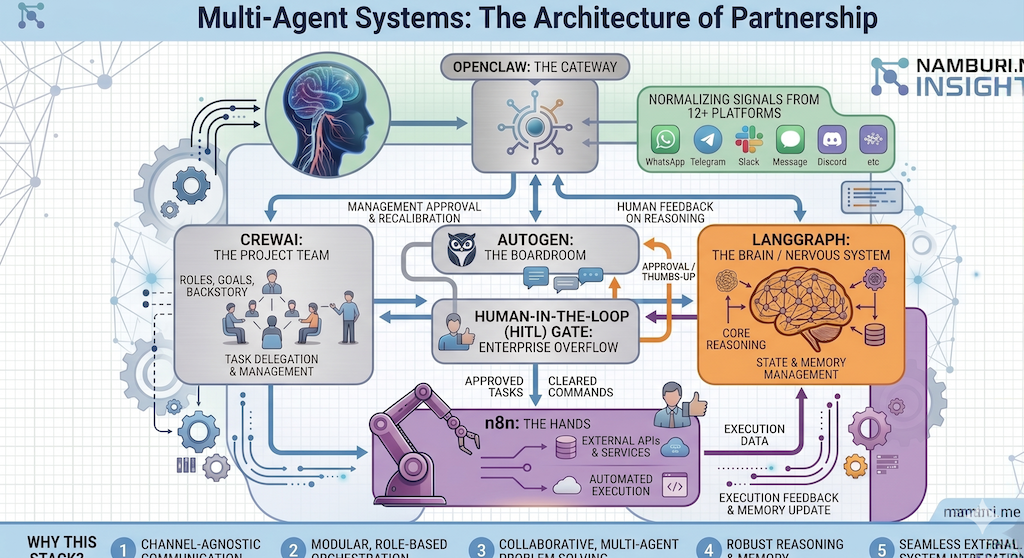
OpenClaw — The Senses
A universal gateway for 12+ apps (WhatsApp, Slack, Discord). The AI becomes a contact in existing workflow—no new apps to install.
CrewAI — The Project Team
Assigns specific roles and goals. Forces agents to act like specialized experts—Researcher, Writer, Coder—eliminating generic, hallucination-prone outputs.
AutoGen — The Boardroom
Different AI models debate and brainstorm. A built-in "second opinion" through multi-model deliberation before any action is taken.
LangGraph — The Brain
The memory and logic substrate. Solves "AI amnesia" by maintaining persistent context across long, multi-turn interactions.
HITL Gate — The Safety Valve
A Human-in-the-Loop gate between thought and action. High-stakes tasks stop here for approval. You remain the final authority.
n8n — The Hands
The automation muscle connecting to tools (CRM, Email, Databases). Turns finalized agent decisions into verified results.
Why This Multi-Agent AI Architecture Works
1 · Channel-Agnostic Communication. One agent, every surface — the same logic and memory regardless of whether the signal arrives via WhatsApp, Slack, or iMessage.
2 · Modular, Role-Based Orchestration. Task delegation happens at the framework level. Swap or add a specialist agent without changing anything else in the stack.
3 · Collaborative, Multi-Agent Problem Solving. Human feedback on AutoGen's reasoning flows back through the HITL gate, triggering recalibration before any action clears. No single model's blind spot becomes a system failure.
4 · Robust Reasoning & Memory. Execution data from n8n feeds back into LangGraph's memory after every action, closing the loop between doing and knowing. The system gets smarter with each completed task.
5 · Seamless External System Integration. The HITL gate is the hard boundary — only approved tasks and cleared commands reach n8n. Every action is explicit, auditable, and controlled.
The goal isn't to automate tasks—it's to augment responsibility. This shift from Prompt Engineering to Systems Engineering is what transforms an AI tool into a trusted partner.
The Bottom Line
The future of enterprise AI isn't a single "God Model" doing everything. It's an orchestrated workforce—each layer doing exactly one job, reliable, under oversight. Six layers, one coherent system. That's partnership by design.